A Grace Blackwell AI Supercomputer on Your Desk
NVIDIA DGX™ Spark belongs to a new class computers designed to build and run AI, enabling developers to prototype, fine-tune and inference large AI models locally and seamlessly deploy to the data center or cloud.
NVIDIA DGX Spark
Powered by the NVIDIA GB10 Grace Blackwell Superchip, NVIDIA DGX™ Spark delivers 1000 AI TOPS of AI performance in a power-efficient, compact form factor. With the NVIDIA AI software stack preinstalled and 128GB of memory, developers can prototype, fine-tune, and inference the latest generation of reasoning AI models from DeepSeek, Meta, Google, and others with up to 200 billion parameters locally, and seamlessly deploy to the data center or cloud.
NVIDIA GB10 Superchip
The NVIDIA Grace Blackwell architecture delivers a powerful system-on-a-chip (SoC) solution combining NVIDIA Blackwell GPU technology with Arm CPU cores to deliver supercomputer level performance in an efficient, compact SoC.
CPU Cores
The GB10 provides 20 Arm cores, 10 Cortex-X925 cores and 10 Cortex-A725 cores.
Blackwell GPU
The GB10 Blackwell GPU provides 6144 CUDA Cores to accelerate graphics and FP32 compute workloads, 5th generation Tensor cores that provide up to 1,000 AI TOPS1 1Theoretical FP4 TOPS performance using sparsity feature of FP4 performance, and 4th generation RT cores that provide real time ray tracing acceleration. The GPU also includes 5th generation NVDEC and 9th generation NVENC engines for accelerated encoding and decoding of MPEG-2, VC-1, H.264 (AVCHD), H.265 (HEVC), VP8, VP9, and AV1 video formats, including support for 4:2:2 H.264 and H.265 video.
128GB LPDDR5x Memory
The DGX Spark features 128GB of coherent, unified LPDDR5x system memory. Accessible to both CPU and GPU, DGX Spark enables users to work with large workloads including AI models of up to 200 billion parameters.
NVIDIA ConnectX®-7 NIC
Equipped with a ConnectX-7 Smart NIC, the DGX Spark provides up to 100 gigabit ethernet (GbE). Connecting two DGX Spark systems via the ConnectX-7 networking port enables users to work with AI models of up to 405 billion parameters.
NVIDIA DGX OS
With the NVIDIA DGX OS pre-installed, the DGX Spark development environment will be familiar to DGX developers. Including Ubuntu Linux, the DGX OS system software makes it easy to move work to DGX Cloud or any accelerated data center or cloud infrastructure. Installed software also includes RTX toolkits and libraries, supporting NVIDIA RTX visualization technologies.
NVIDIA AI Software
In addition to the DGX OS, DGX Spark includes the NVIDIA AI software stack which includes CUDA, CUDA-X toolkits and libraries to enable AI developers to quickly bring up their AI projects and workflows. Users can install their favorite AI frameworks, SDKs, and services such as PyTorch, TensorFlow, or Jupyter Notebooks or take advantage of NVIDIA platforms and frameworks such as NVIDIA Isaac Sim™, NVIDIA Metropolis, or NVIDIA Holoscan and NVIDIA NIMs and AI Blueprint example workflows.
NVIDIA DGX Spark Founders Edition Product Design
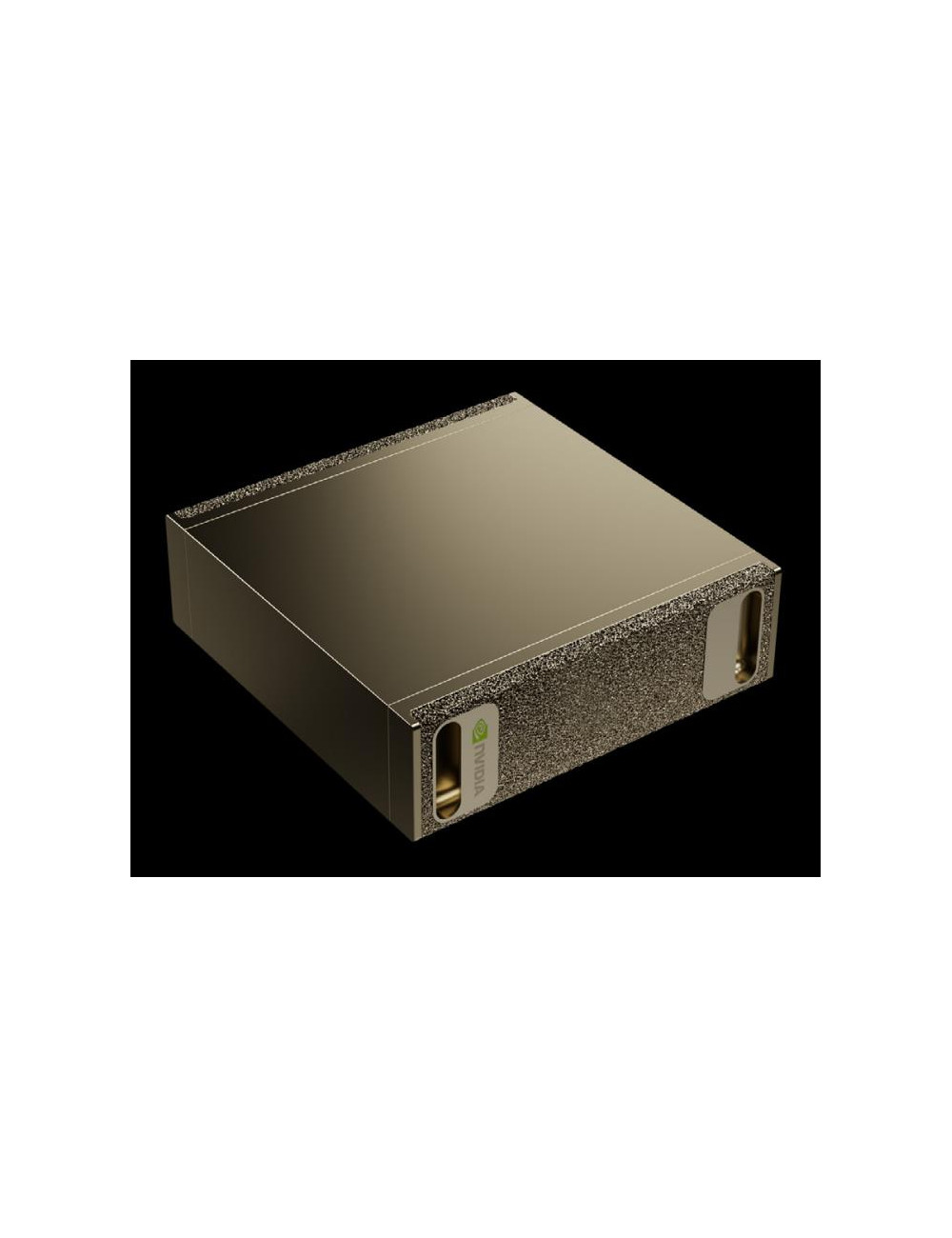
The NVIDIA DGX Spark is a compact desktop system, measuring 150 mm L x 150 mm W x 50.5 mm H, able to fit onto any desktop with minimal space required. The system is designed to look like the original DGX 1 system, the original AI supercomputer that was first delivered to customers in 2016, making it an attractive addition to any workspace.
- NVIDIA GB10 Superchip
- 128 GB of Coherent Unified System Memory
- NVIDIA ConnectX Networking
- NVIDIA AI Software Stack

 lietuvių kalba
 English